



Metal Zippers for Jeans, Apparel and Leather Goods
What Is a Metal Zipper?
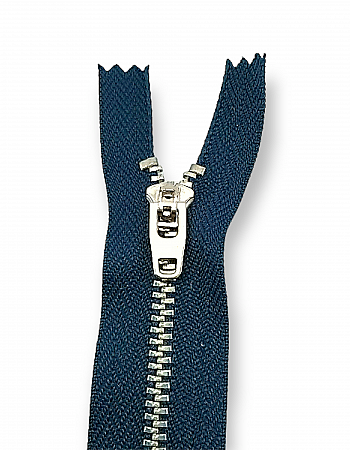
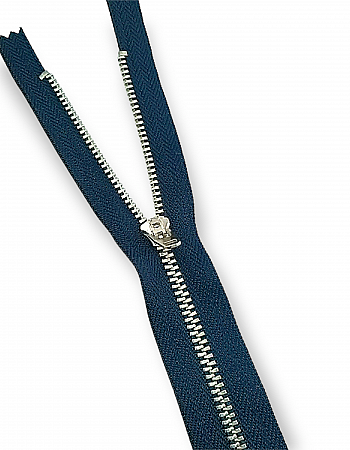
A metal zipper uses separate metal elements fixed to both sides of textile zipper tape. As the slider moves, the opposing teeth interlock to close the zipper and separate to open it.
Selection must consider more than appearance. Confirm the actual tooth alloy, surface finish, zipper size, end construction, slider, tape dimensions and intended fabric.
Metal Zipper Selection Guide
| Application | Suggested Zipper | Important Check |
|---|---|---|
| Jeans and denim skirts | Short closed-end brass or verified metal-tooth zipper | Match the fly length, locking slider and garment-wash process. |
| Trousers and workwear | Low- or medium-profile closed-end metal zipper | Check that the teeth do not create excessive bulk. |
| Jacket, coat and leather pocket | Closed-end medium-profile metal zipper | Measure the pocket opening and verify the finish. |
| Leather bag and accessory | Closed-end or verified continuous metal zipper | Test the tooth stiffness, curves and material layers. |
| Jacket centre front | Open-end separating metal zipper | Verify the insertion pin, retainer box and finished length. |
| Long coat | Long open-end or verified two-way metal zipper | Two sliders are required for lower-opening operation. |
Metal Tooth Materials and Finishes
Brass and other copper alloys are commonly used for metal zipper teeth. Aluminium and other documented metals may be used for specific products.
Product data should separate:
- Tooth material: Brass, copper alloy, aluminium or another verified metal
- Tooth finish: Natural brass, nickel, antique brass, black nickel, copper or another verified finish
- Zipper tape: The documented textile tape material
- Slider material and finish: Listed separately where known
A nickel finish does not necessarily mean that the teeth are manufactured from solid nickel.
Genuine Metal Teeth vs. Metallic-Look Zippers
| Construction | Actual Chain Material | Correct Description |
|---|---|---|
| Genuine metal zipper | Verified metal elements | Metal-tooth zipper |
| Metallic-look coil | Nylon or polyester spiral | Metallic-look nylon coil zipper |
| Metallic-look molded teeth | Molded plastic | Metallic-look molded plastic zipper |
| Nylon zipper with metal puller | Nylon coil with a metal pull tab | Nylon zipper with metal puller |
Closed-End Metal Zippers
A closed-end zipper remains permanently joined at the bottom. It is commonly used in jeans, trousers, skirts, pockets, bags, boots and fixed-bottom accessory closures.
Open-End and Two-Way Metal Zippers
An open-end separating zipper uses an insertion pin and retainer box so both tape halves detach completely. It is used for jackets, leather garments and coats.
Separating does not automatically mean two-way. A two-way separating zipper must also have two sliders and verified lower-opening operation.
How to Select a Jeans Zipper
- Measure the functional fly opening.
- Confirm closed-end construction.
- Identify the tooth alloy and finish separately.
- Check the locking or semi-automatic slider function.
- Match the tape color to the denim and fly facing.
- Test the complete zipper through the intended garment-wash process.
How Is a Metal Zipper Measured?
For a closed-end zipper, measure the functional chain from the top stop to the bottom stop. For an open-end zipper, measure to the functional end of the retainer-box assembly. Do not include additional tape beyond the working chain.
Metal Zippers and Fabric Weight
Metal chains are generally less flexible and more visually pronounced than coil chains. Lightweight fabric may require additional seam support so that the zipper does not pull or distort the garment panel.
Approve the zipper with the actual outer fabric, lining, seam allowance and production method.
Garment Washing and Finish Testing
- Test the zipper with the real denim, dye and wash process.
- Do not promise chemical, bleach or corrosion resistance without documented testing.
- Inspect the tooth finish, tape color and slider after the sample wash.
- Do not apply excessive force to a contaminated or obstructed slider.
- Missing or deformed teeth may require complete zipper replacement.
Common Product-Data Errors
- Do not classify metallic-look coil as genuine metal chain.
- Do not identify a zipper as metal only because it has a metal slider or pull tab.
- Do not combine tooth material and tape material in one field.
- Do not list nickel as the base alloy unless it is specifically documented.
- Do not describe every separating zipper as two-way.
- Do not approve repair compatibility from length alone.
- Do not claim wash or chemical resistance without testing.
Frequently Asked Questions
What are metal zipper teeth made from?
Metal zipper teeth may be made from brass, another copper alloy, aluminium or a different documented metal. Check the exact material in the product specifications.
Are nickel zipper teeth made entirely from nickel?
Not necessarily. Nickel usually describes a surface color or finish. The base tooth alloy must be listed separately.
Is a metallic-look nylon zipper a metal zipper?
No. If the chain is nylon coil, the zipper is not a genuine metal-tooth zipper even when its surface looks metallic.
Which metal zipper should be used for jeans?
Use a short closed-end metal zipper that matches the fly length, fabric and slider requirement. Test it with the actual denim wash process.
Is every open-end metal zipper two-way?
No. Open-end means the tapes can separate completely. A two-way zipper must also have two sliders and lower-opening operation.
How is a metal zipper measured?
Measure the functional chain between the top stop and the bottom stop or open-end retainer box. Do not include extra sewing tape.
Can only the slider be replaced on a damaged metal zipper?
Slider replacement may work when all teeth and the tape remain intact. Missing, bent or damaged teeth may require complete zipper replacement.
Last updated: July 22, 2026
Business: E-Fermuar — zipper, slider and textile accessory supplier, Istanbul, Türkiye.
-350x450h.png "Metal Zipper 25 cm #5 0,27 yrd Metal Toothed White Bottom ZPHSN0025T5")
-350x450h.png "Metal Zipper 25 cm #5 0,27 yrd Metal Toothed White Bottom ZPHSN0025T5")